Long-stay and flexible living accommodation is furnished, service-enabled property used by flexible living operators for stays that are longer or harder to run than a normal hotel visit. It includes corporate housing, serviced apartments, aparthotels, extended stay, co-living, and housing for relocation, insurance, healthcare, government, and workforce clients. The number of nights matters less than the operating model behind the stay.
In this part
- What counts as long-stay and flexible living accommodation?
- It is the operating model, not the length of stay
- Corporate housing, serviced apartments and other names for the same model
- Why asset owners are moving to flexible stay models
- What that means for software
- Why a traditional PMS is not enough
- Who needs long-stay and flexible living software?
- The questions to ask change too
Key takeaways
- A stay of seven nights or a year can both count as long-stay. The real test is the work behind it.
- Corporate housing, serviced apartments, flexible living, and co-living are often different names for the same business model.
- Owners use flexible stay models to lift occupancy, revenue, margin, and NOI.
- Hotel, vacation rental, and residential software each cover part of the job. Long-stay operators need a system that runs the business behind the stay.
What counts as long-stay and flexible living accommodation?
The category covers furnished, service-enabled property operations that run stays longer or more complex than a standard hotel visit. It includes:
 Corporate and relocation
 Hospitality stays
 Residential living
 Institutional and emergency
It can also overlap with residential real estate when an owner uses furnished, service-enabled, or flexible-stay inventory to improve asset performance.
It is the operating model, not the length of stay
A stay may last seven nights, six weeks, three months, or a year. Length matters, but the operating model matters more.
A business sits in long-stay and flexible living territory if any of these apply:
- The stay involves a corporate client, insurer, relocation partner, healthcare group, owner, landlord, supplier, or government agency.
- Billing goes beyond simple monthly rent or a nightly folio.
- The unit needs repeat service, housekeeping, inspections, or maintenance.
- The stay can be extended, shortened, moved, split, or changed after it starts.
- Finance needs to see revenue, costs, deposits, payables, owner obligations, or margin by unit, client, market, or stay type.
- Several teams work on the same reservation, contract, unit, and customer.
That is why a seven-night serviced apartment stay can be very different from a seven-night vacation rental. The calendar may look the same, but the business model does not. In this category, a stay is less like a booking and more like a managed workflow.
Corporate housing, serviced apartments and other names for the same model
The category is hard to pin down because different markets use different terms. The label changes with the buyer, the region, and the use case, but the model underneath is the same.
| Term | Where it’s common | Typical clients and use |
|---|---|---|
| Corporate housing | United States | Furnished apartments for corporate clients, relocating employees, consultants, project teams, government workers, and temporary assignees |
| Serviced apartments | United Kingdom, Europe, and parts of Asia-Pacific | Furnished apartments with hospitality-style service, housekeeping, direct booking, and a mix of business and leisure demand |
| Flexible living, co-living, furnished living, serviced residences, hybrid living | Real estate and residential markets | Owners and operators using furnished, flexible-stay inventory close to the residential asset class |
| Temporary accommodation, relocation housing, insurance lodging, patient housing, workforce housing, emergency accommodation | Insurance, relocation, government, military, healthcare, and disaster response | Temporary housing for insureds, relocating employees, healthcare staff, patients, project workers, and people displaced by disasters |
An insurance housing provider may not think of itself as a serviced apartment operator. A co-living operator cannot call itself corporate housing. A real estate owner might just call it a yield strategy. Each still needs software that handles complex stays, furnished inventory, operational workflows, financial accuracy, and multiple stakeholders.
Long-stay and flexible living is the umbrella term used here because it covers the category more fully than any single old label.
If your stays need operational control, financial accuracy, workflow coordination, and asset-level visibility beyond a hotel, vacation rental, or standard residential model, you are in this category, no matter what you call it.
Why asset owners are moving to flexible stay models
Flexible living is often described as a guest trend. Companies want furnished accommodation without long commitments. Relocating employees, insured clients, healthcare staff, and project workers need homes for weeks or months, not just nights or years.
That is true. But for owners, investors, and operators, the deeper driver is portfolio performance. They are under pressure to improve occupancy, grow revenue, cut empty periods, and increase NOI. In many markets, the best way to do that is to stop treating every unit the same and match each unit to the demand in front of it.
- One unit may do best as a longer-term furnished rental.
- Another may earn more as a medium-stay corporate or relocation unit.
- Another may earn more from shorter serviced apartment stays in some seasons.
- A building may need one mix of stay lengths in January and another in June.
One building, a year of stays
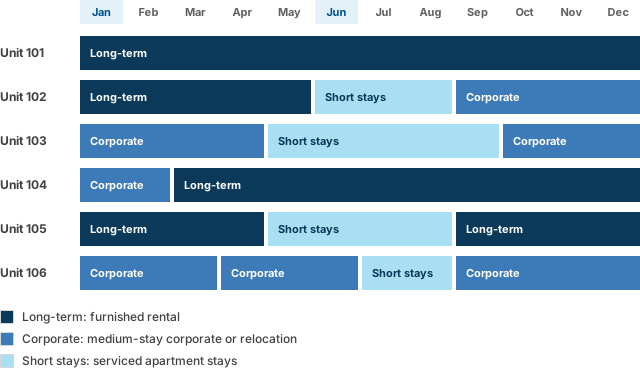
The operator’s question shifts from “How do we fill this unit?” to: What is the best use of this unit, in this market, right now, given the demand available and the cost of serving it?
What that means for software
The system has to support that flexibility without creating chaos. Operators need to know:
- Which units should be shown to which demand channels
- Which stay lengths are most profitable in each market
- Which units are lagging
- Which channels fill gaps and which add complexity
- Which stay types deliver the best margin after service costs
- How to split inventory across short, medium, and long-stay demand
- How a change in stay length affects housekeeping, billing, taxes, reporting, and margin
Flexible living is not what happens when a property operator becomes a hotel or vacation rental company. It is what happens when an owner uses variable stay lengths, furnished inventory, and service-enabled operations to improve occupancy, revenue, margin, and NOI.
Why a traditional PMS is not enough
Most operators still say property management system, or PMS. For corporate housing operators and serviced apartment operators, a long-stay PMS must do more than manage rooms and rates. That is why serviced apartment software and flexible living software need the same core data, even when the market uses different labels.
Long-stay and flexible living operators need all four
 Hotel PMS
Best for Managing transient guests staying a night or two
Built around Rooms, rates, reservations, check-ins, check-outs, and folios
 Vacation rental software
Best for Distributing and managing leisure short-term inventory
Built around Listings, channels, calendars, owner statements, and guest messaging
 Residential property management software
Best for Managing standard residential portfolios
Built around Tenants, leases, rent rolls, maintenance, and resident admin
 Accounting or ERP software
Best for Recording financial activity after the business has already created it
Built around Financial records, business processes, and reporting
Long-stay and flexible living operators sit across all four. They manage real estate but are not just landlords. They provide furnished accommodation but are not just hotels. They accept shorter stays but are not vacation rental managers. They need strong accounting but are not just buying accounting software.
Behind every stay are reservations, contracts, inventory choices, service levels, housekeeping, maintenance, extensions, early departures, billing rules, client relationships, supplier obligations, owner reporting, payments, and financial controls. The stay is only the visible part.
So the question changes from “Which PMS should we buy?” to: Which system should run the business behind every stay, every unit, every workflow, and every financial outcome?
For these operators, the right software is not just where bookings live. It is where the business runs.
Who needs long-stay and flexible living software?
This kind of software is for property-backed operators whose business goes beyond the booking or the lease. That usually means teams that:
- Manage furnished or service-enabled accommodation across short, medium, and long stays
- Coordinate reservations, inventory, housekeeping, maintenance, billing, payments, accounting, reporting, and client service
- Serve corporate clients, residents, relocation companies, insurers, healthcare groups, government agencies, workforce programs, owners, landlords, suppliers, or investors
- Handle stays that change after they begin
- Need finance to trust the numbers before they reach the accounting system
- Need visibility across markets, units, clients, stay types, service levels, margins, occupancy, and NOI
It is not mainly for traditional hotels, leisure-focused vacation rental managers, standard residential operators, or businesses that only need accounting software. Each of those has its own software category. In long-stay and flexible living, financial truth starts before the accounting system, in the operating activity of the stay itself.
The questions to ask change too
- Not just: Can it take a booking? But: Can it manage what happens after the booking?
- Not just: Can it connect to accounting? But: Can it generate clean operational accounting before anyone pushes anything to accounting?
- Not just: Can it show availability? But: Can it help us decide how to use inventory across short, medium, and long-stay demand?
- Not just: Can it support flexible stays? But: Can it show whether flexible stays improve occupancy, revenue, margin, and NOI after operating cost?
- Not just: Can it store data? But: Can it help our teams act?
Beyond PMS updates
Get every new part as it’s released
We’ll email you when the next part goes live.